Showing posts with label math. Show all posts

Wednesday, April 17, 2024

Experienced Math Tutor Best In Queens

0 comments

Demystify math! Would you rather memorize seemingly arbitrary rules or understand math? I will make sure that the concept is understood and make math logical. I have over 20 years experience teaching 3rd through 8th grade and high school topics. I can meet you in Queens, Manhattan, or Brooklyn for $100/hour or online for $60. New introductory rates! DM me below to set up your first session and I promise you that you will look forward to math and that math will become innate.

During the 2008 school year, I was already an experienced teacher when the DOE decided to publish data on teachers' performances. I scored #1 in Queens. You can check, too! Contact me for my name. My specialty is making connections, both interpersonally with my scholars, and intrapersonally, making math logical - which it is. Stop learning math and discover it instead with a private tutor that will tailor instruction to you.

Call me now at nein won s3v3n, fore s3v3n sicks, won s3v3n won three. 

Thursday, August 6, 2020

How My Never Mastering Spanish Helps ENLs

1 comments

I guess when you live in Metropolis, USA, things happen. Nine million people squashed onto little islands, we jostle around a bit more than other places. It's the biggest city because it is a living city, not some office buildings clustered inside of business extensions to the highways. People come and go, and in my borough, they mostly come, come, come, and I, for one, welcome them. Queens has not much in the way of attractions, but if you travel for the people, then you can skip Times Square. My students speak Tagalog, Polish, Urdu, Ki'iche, Fulani, CebuanoAlbanian, Russian, Tibetan, Serbo-Croatian, Ilocano, Arabic, Mandarin, Bengali, Kreyòl, Ukrainian, Hindi...I'm forgetting something...

Oh, yeah. Spanish. I have lots of Spanish speaking kids. I know a few words in almost all the languages that my students speak. Some of them, such as the Urdu word for "factor", pronounced "ansi", is the result of modeling factoring for 2 twin boys who spoke no English, and no one else in the class spoke Urdu. Others, because I have friends and neighbors who teach me a few phrases. I've always been fascinated by languages. I'm where I should be here in Queens. But, of those languages, I only can
La Uniesfera
passably "speak" in Spanish. 

I took two years of high school Spanish, and still cannot conjugate a verb beyond the present tense, and sometimes not that, if it's irregular. But, I am fluent in French, and between my nouns and verbs and specific math and teaching terms (tarea, mochilla, cuaderno) I can be understood, if only by committee. It gets the kids talking, even if only for a moment, about what I actually meant, which they all have an opinion about, because I'm all over the place with Spanish. Kind of like they are with English. And math.

This, I find, is engaging for the kids, and models how they should attack the problem of math: headlong. I mean, hit a ratio problem with the circumference formula kind of gusto! Get people talking. Someone's going to throw up their hand and call out, "NO!". Disregard, as I do, the certainty that a small-minded admin will "ding" me, on the "rubric" for this, as not having set up classroom expectations. I will then ask why, and, rather than the child answering, I'll thank him or her for starting the conversation, and, as I see others who are also indicating "no", I'll ask one of them why they agree. And so on. 

In other words, I can really teach. I know my kids. I am teaching my kids. Not all, because no one can get them all. I'm dealing with kids with many, many issues, not the least of which is puberty. They don't make great choices. The love of my life, Tootie Pie, is the exact age as my students. Sometimes she has moments of brilliance, and other times I think she has hummus for brains. When you throw in language and poverty, food instability, and COVID...

I love teaching, because I have to put on an interactive show. In the "precedented" times, I would perform 12 shows a week. It's hard enough to get a crowd going at 8:12 a.m., especially middle schoolers who have the natural biorhythms of Dracula. Try doing it to a bunch of blocked video feeds! It can be done. It will take monumental effort and a LOT OF TIME! If the small-minded powers-that-be have their way, they will push an unrealistic timeline for curriculum to be given, when students don't have access to reliable internet. Inexperienced teachers will follow the dictum to the tee, until everyone finds out, in the end, that it didn't work for exactly the reasons we said. I'm a bit salty. Yeah.

But NYC can really take a punch! And even though my kids lived in the ironically named epicenter of CoVid, Corona, they will, and I will, and we will model for the country how it's done. Because we have been knocked down time and again, and we're at so many disadvantages here, but that only makes us stronger. 

Friday, January 18, 2013

My Dollhouse May Soon Be Condemned for Structural Problems

2 comments
New direction for
the capiz chandelier
Hi!  There is going to be a slow-down in the rate of posts since I returned to work this week.  Mini making is taking a backseat, but it was fun being able to "play" all day while it lasted.  Teaching is such an all-consuming profession; it leaves little time or energy for any other thing. 

I switched gears on the dining room lamp yet again, not in the design, but in the process by which I am achieving the design.  Rather than stringing the disks together, which is not working out with glue, and doesn't hang right with the same stringing technique that the full-scale world uses - it seems that miniscule circles made of plastic don't have enough weight to pull the string taught - I am fusing the disks together.  I provided a sneak peak, above.  Like most other projects, it is tedious, and time-consuming.  And I don't quite know how it will turn out.  In a way, it's exciting.  Oh, and the "one milk cap full of hole punch confetti" comment on my last post?  More like, fifteen half-pink milk container fulls and one serious case of carpal tunnel.  According to my calculations (WARNING: math ahead!!!), if I have a square pendant, with 3 strands of six circles on the inside, and 5 strands of three disks on the outside, that would mean I would need to punch:
  • 6 x 3 x 4 (six disks long, by three strands per side, by four sides) =    72
  • 3 x 5 x 4 (three disks long, by five strands per side, by four sides) =  60
Which means I need to punch 72 + 60 disks or 132 punches.  YeOuch!

My shade
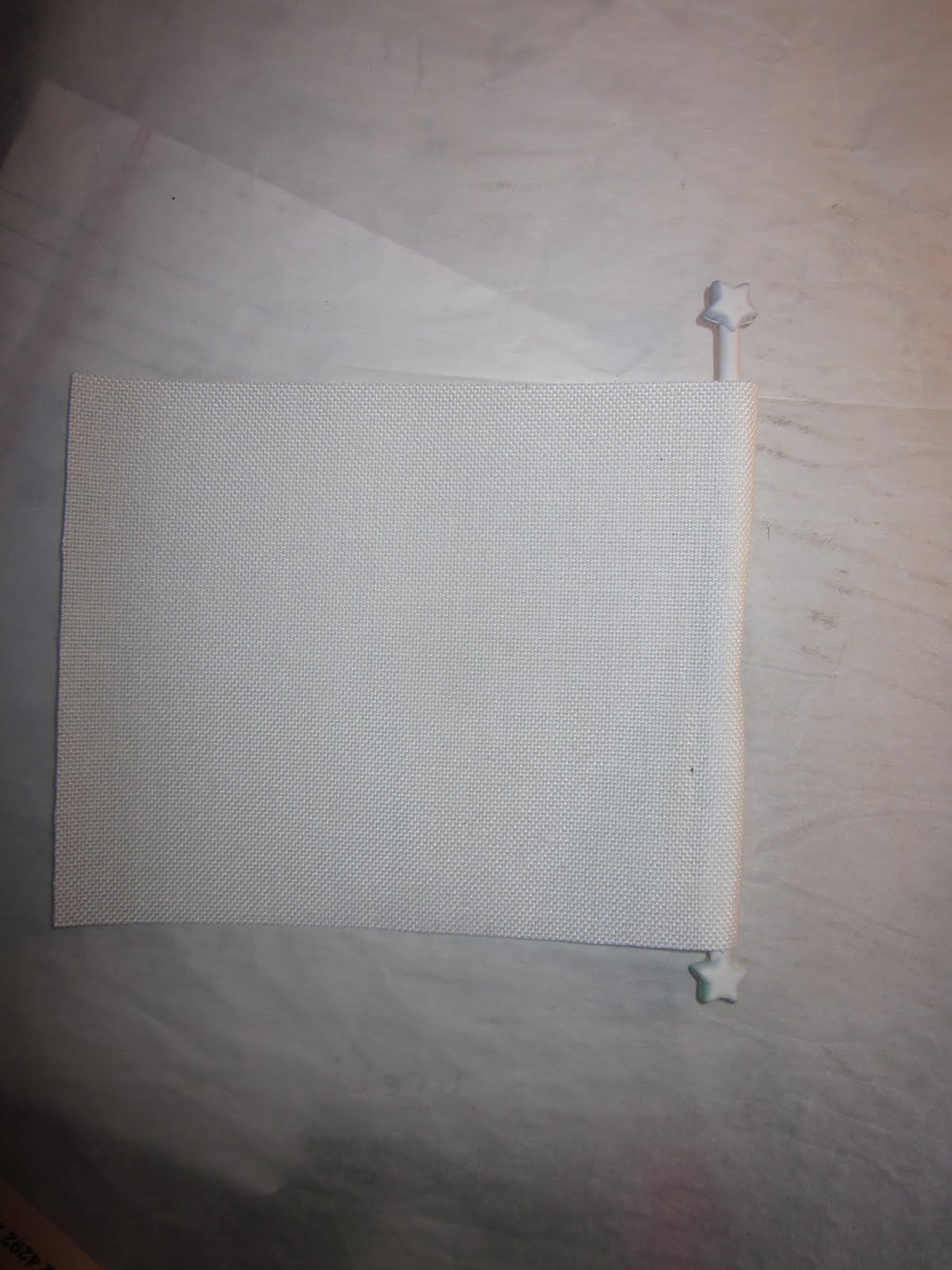
Also, I finished one window covering for the master bedroom.  The drapery hardware is a plastic coffee stirrer with two star beads as finials, and the fabric is a free swatch from the Shade Store.  Shhhhh!  That is our secret, the Shade Store thing, kay?  I fabric glued the cut swatch to the straw.  Voila.
My Arco lamp had its neck
broken
Second floor collapsing onto
kitchen.

Another mini task taking up my time is fixing up what I've already completed.  One step forward, two steps back.  This is a toy, and it is being played with, and it is sustaining damage.  My Arco lamp proved to be "unsuitable for play".  The floor above the kitchen caved in.  I want the dollhouse to be a pristine, museum quality piece; my daughter wants it to be "well loved".  I'm trying to strike the same balance in my own home.  For those of you keeping score, Tootie Pie is winning.

Thursday, November 29, 2012

First Undersized Urbanite Project - A Herringbone Pattern False Floor

2 comments
Since I am renovating a Keystone of Boston dollhouse that is in very, very good condition, I want to modify it in a way that maintains its value.  Not that I think I could actually get money for it one day, but who knows?  Maybe it will one day be auctionned off at Christies.  But, realistically, I want to be able to change it without destroying it.  So, the first project that I have taken on is to redo the floor in the main room.  The main room is a combination living room and dining room, with a half wall partitioning them.  So, the actual measurements are a whopping 15" x 24".  I am making the "hardwood" flooring from coffee stirrers.  Cost: $0.00.  Thank you, Trader Joe's and Barnes and Noble and Starbucks.  Each stirrer is 5.5" long, and my pattern requires cutting them to 7/8 of an inch long.  I will definitely regret this decision later, if I do not already realize my foolhardiness.

What I've done so far is fashion a cardboard footprint.  I had to glue two 8.5" x 11" pieces (which, for those math phobes out there, makes 17" x 22") and made up the rest with strips.  Then, I surrounded the perimeter with full coffee stirrers, and I will painstakingly and hopefully patiently glue the tiny, tiny strips of wood into a zigzag pattern.  Let's do the math, shall we?

Area of floor: 360 square inches (minus around 7 square inches for the cutout for the stair landing)

Area of one wood strip: 0.1640625 square inches (dimensions 3/16" x 7/8" or 0.1875" x 0.875")

Number of wood strips needed to cover floor: 360 ÷ 0.1640625 = 2194


Or, in other words, I'm going to be gluing for a very, very long time.  Let's hope it turns out okay, and that I survive the ordeal with most of my sanity intact.  Or is it already gone?

Friday, June 15, 2012

Miniature Moon Landing Classroom Project

0 comments
The school year is winding down.  My school has a contest at the end of the year to see who can put together the best scene, and I got the year 1969.  Being a math teacher, I had the students figure out how many of a certain item it would take to reach the moon.  Did you know that it is:
  • 238,855 miles
  • 1,261,154,400 feet
  • 15,133,852,800 inches
  • 252,230,880 students
  • 242,141,644,800 quarters
  • 3,026,770,560 SpongeBob Square Pants
  • 867,965 Empire State buildings
  • A pile of dollar bills totaling $3,783,463,200,000
To the moon?  Those calculations, using rates, ratios and proportions, took my students almost a full week, with calculators!  Heaven forbid they use a pencil and basic math facts to reach those numbers!  Then, boring math part over, we got to the fun part: illustrating the astronomical numbers.  Having time to spare (yes, after a week of calculations), we decided to build the Apollo 11 rocket.  Then, the deadline was pushed back, so we added the Eagle (the lunar landing module).  Then, we were told to decorate the doors (my room has two), so one was a newspaper frontpage (July 21, 1969), and the other is of what is supposed to be Kennedy giving his "We choose to go to the Moon" speech, although it looks more like the Elephant man with a hemifacial spasm or Bell's palsy.  And then, I was told to decorate yet another wall, on which we will create the parachutes with the splash down command module attached, landing in the ocean (pictures to come).  My goodness, am I having fun!  It combines so many of my interests: thrifting (I bought a plush astronaut), scavaging (the birdcage turned into a parachute), crafts (there is a lot of cardboard, tracing, painting, and glitter involved), math, and miniatures. 
Moon scene on bottom, artistic renderings
of items stacked to the moon (not to scale)
The Apollo 11 rocket, with
2 astronauts (one atop ladder
in door, other in window).


JFK's famous "We choose to go the
the Moon" speech.  On the right is his
words, coming from his mouth, on
the left is his dream (moon and
 astronaut), coming from his head.


The Eagle, the lunar landing module
So much fun!  Fun projects brings out different aspects in my students that I don't get to see with the big test looming most of the year.  One of my students brought in the drawing underneath the Eagle model in the picture above.  It is a wonderful picture!  And I get to see the correlation between intelligence and common sense.  For example, a high scoring student can figure out how to cover a semicircular parachute shape in five minutes without direction, but when a low student is asked to cut something out, he asks me, "How?".  "Oh, I'd try scissors", I reply, as patiently as I can manage.  "Where are the scissors?", he asks, with a pair literally right under his nose.  "See if you can't look around and find a pair", I respond, much less patiently.  And then there was the child who could not wrap his head around how I came to have a birdcage if I never had a bird.  Sweetie, someone else had a bird and they were throwing out the cage, okay?  Follow up question: "Was it you who had the bird?".  Life skills, people!  How are you going to manage in the world?  In any case, I have a week and a half left before my summer break.  Patience, dear self.  Patience, patience, patience.

The barely legible newspaper
headline! They should have used
 a larger, more impressive font!
My parachute landings.  Whew!

Wednesday, April 4, 2012

Free Math SmartBoard Math Lessons

0 comments
In my biography for this blog, I assert that I know middle school math better than anyone else.  While this is something of a stretch, it is almost certainly true that I am more familiar with middle school math than you do, even if you happen to be a math teacher.  Three years ago, I was teaching Greatest Common Factor and Least Common Multiple, and I told the students that I was demonstrating just a couple of ways to find them.  One student asked if we could see some other methods, and the other students chimed in that they, too, would like a quick synopsis of other procedures.  While it may seem unbelieveable that children would want to know more ways than I'd already taught them on this rather dry, not heavily applicable to the real-world skill, remember that they would do anything to get a teacher off-topic, if only for a moment.  So, I indulged them, and while I was in the midst of my impromptu lesson I had one of those out-of-body experiences where I could see myself and I realized that I know a little too much about finding GCF and LCM.  I was thinking, gee, Linda, how did you come to know so much about this topic, and isn't it a bit strange? 
 
They try this problem, with their
fraction pieces and a timer
I have been wanting to write a guest blog, and my first post is for a "best practices" teaching website.  In this effort, I have been taking screenshots of my smartboard lessons.  These lessons represent years of work and experience, so why not show them off? 


A slide and its progression. 
From top to bottom:
the old style visual aid, wrapped in
rubber bands to hold it together;
the same prism, now on the
smart board, peeling off the layers,
breaking off the individual
 cubes and displaying
the solution.

Then, reveal correct answer, and misconception.
The screens I chose to show in the guest blog demonstrate the use of manipulatives in the classroom, which is considered a good practice, methods to dispel misconceptions, which is extremely difficult to do, and engaging, hand-on lessons, which, if you're a teacher, you know means headaches!  I've developed these lessons for use with the smartboard, and there are hundreds of slides with cartoons, turn and talks, think pair shares, reflections, procedures, do nows and links to interactive websites.  The instant access to visuals is a godsend for a teacher who is accustomed to having to draw such things as turnstiles and radiometers, to little effect.  But even better are the interactive elements.  The smartboard timers help keep students on task, and they even give me a better feel for how long three minutes really is.  I no longer have to circle the classroom with a rectangular prism made of snap cubes in my hand, demonstrating what the dimensions of the prism are.  I can spin spinners, flip coins, or toss dice without having to tell the students to "trust me, it's heads".  I do not have to buy the incredibly expensive quad-ruled chart paper to teach the coordinate plane or graphing.  And I don't have the aggravation of other teachers in my classroom blithely taking a sheet or two without permission and using them indiscriminately after I take such care to use them sparingly by plotting things in pencil and erasing it clean before the next class.  That's over $2.00 a sheet, people!  And, while I'm on the subject, do you have any idea how expensive overhead projector lightbulbs are?  They're not cheap!  Don't leave it on for the whole period, because the fan doesn't work and it's going to overheat!  I'm not paid enough for these supplies!!!  

Ahem, <straightening my tie>, where was I?  I like the smartboard.  For those of you who are interested, this is a tiny glimpse of my life as a teacher.  For fellow teachers, if you'd like copies of my smartboard lessons, I'd be more than happy to share them.  You don't even need a smartboard to use them, just a computer and a projector and a copy of the software.  This is how I use it, because I no longer have a smartboard, either.  I have most middle school math topics done, and a few 6th and 7th grade science lessons.  Leave a comment and I'll send you them.  

And if you're curious about the GCF and LCM, first off let me say that you're a bit strange, too.  No, I'm kidding: intellectual curiosity is one of the great gifts of being a human.  But follow this blog, and we just may cover it, like it or not!

Thursday, March 29, 2012

Real World Applications of Math

0 comments
Dowel + mirror + paint + protractor + ruler =
a $300 mirror made for $10.
How do you like THAT math? 
"When are we ever going to use this?"  I hear this refrain from my middle school students quite a bit.  The obvious, though not satisfying, answer is "on the test next week".  A more thoughtful response, but mostly lost upon tweens, is that math, like any academic pursuit, builds different neural pathways that help us become rational, problem-solving adults.  However, truthfully, a lot of math in the upper grades they may never use (I'm looking at you, square roots of negative numbers and surface area of a triangular prism), but most of middle school math is used in real world situations.  Of course, we want kids to be able to balance checkbooks, make sure they're using coupons in the right order (not that you're allowed to use more than one coupon that often anymore), make change correctly, or to maybe one day use the circumference formula to determine if the drain snake is reaching all the way to the basement without having to uncoil it.  The latter scenario could probably only occur in a household with two math teachers in it.

If you'd like to make this pelmet someday,
you'll need math.
I just received notification that my first project on DonorsChoose is now fully funded.  I am going to have the students make miniatures.  Math and miniatures do overlap in that miniatures are scaled down versions of real world items.  Scale factors and proportions need to be considered in miniatures.  The students will research an item that they would like to create, and then they will find the dimensions of this item, scale the dimensions down, and then build them.  I'm hoping to appeal to the nearly universal love of mushing clay and having small things to cherish.  I hope they respond to it.  I used clay one other time, during a cross-curricular project on Mesopotamian math, where the students had to use cuneiform to create their own equations on a "tablet".  It enlivened a lesson about base-60 number systems (yawn) and Iraq (not the most popular country circa 2005).  They loved it, I enjoyed it, and it's a lesson I still remember some 6 or 7 years later. 

In my DIY decorating, I have had to use ratios (mixing plastic and rubber compounds), angles (to measure rays on a starburst mirror), create nets for boxes, transform patterns, etc.  I have always loved math; in the beginning because it was definitive and exact, then because I was good at it, and today because I appreciate the wonder and miracle inherent in this human invention in its interplay with the natural world.  Getting kids to appreciate math, especially in this day and age where entertainment is everywhere, "covering" the material for the standardized test is critical, and immediate gratification does not encourage subtle discoveries nor small victories, is the hard part.

Monday, March 5, 2012

Unreasonable Effectiveness

0 comments
The mold box worked well. 
The mold, however,
was sadly a complete bust.

Lego scaffolding as glue dries
Since I assume most of you are not holding a master's of education in Mathematics, you may not be familiar with the phrase "the unreasonable effectiveness of mathematics".  It was coined by Nobel Laureate Eugene Wigner in a paper of the same name.  It basically states that math not only describes but predicts phenomena in the natural world, which, if you think about it, is amazing.  Some famous examples are when Newton invented calculus before he needed it for his Laws of Motion (was this man ever a genius!), Maxwell predicted radio waves with his equations before Heinrich Hertz detected them, and how the seemingly quixotic 19th century knot theory work eventually helped explain quantum field theory.  No one could imagine life without their cellphones, but did you know that without fractals, in order to pick up all of the frequencies for Bluetooth, walkie-talkie and Wi-Fi, it would look like a porcupine?  And even though we haven't found them yet, Einstein presaged the existence of black holes.  Math is the bomb (literally, if we're talking about the A-bomb)!  Ha!  Math humor.

A lego lathe!!!
Ah-hem...There is a less well-known phrase called "the unreasonable effectiveness of Legos", which pertains to the unexplained usefulness in miniature making of the already very cool Lego.  The phrase is not as famous because I just made it up.  I have used it as doll house scaffolding, as well as an easily assembled and disassembled mold box.  Has anyone found another use for Legos besides their use as a building toy?  I can envision all sorts of uses.
 

The Hard Way Copyright © 2012 Design by Ipietoon Blogger Template

Blogging tips